
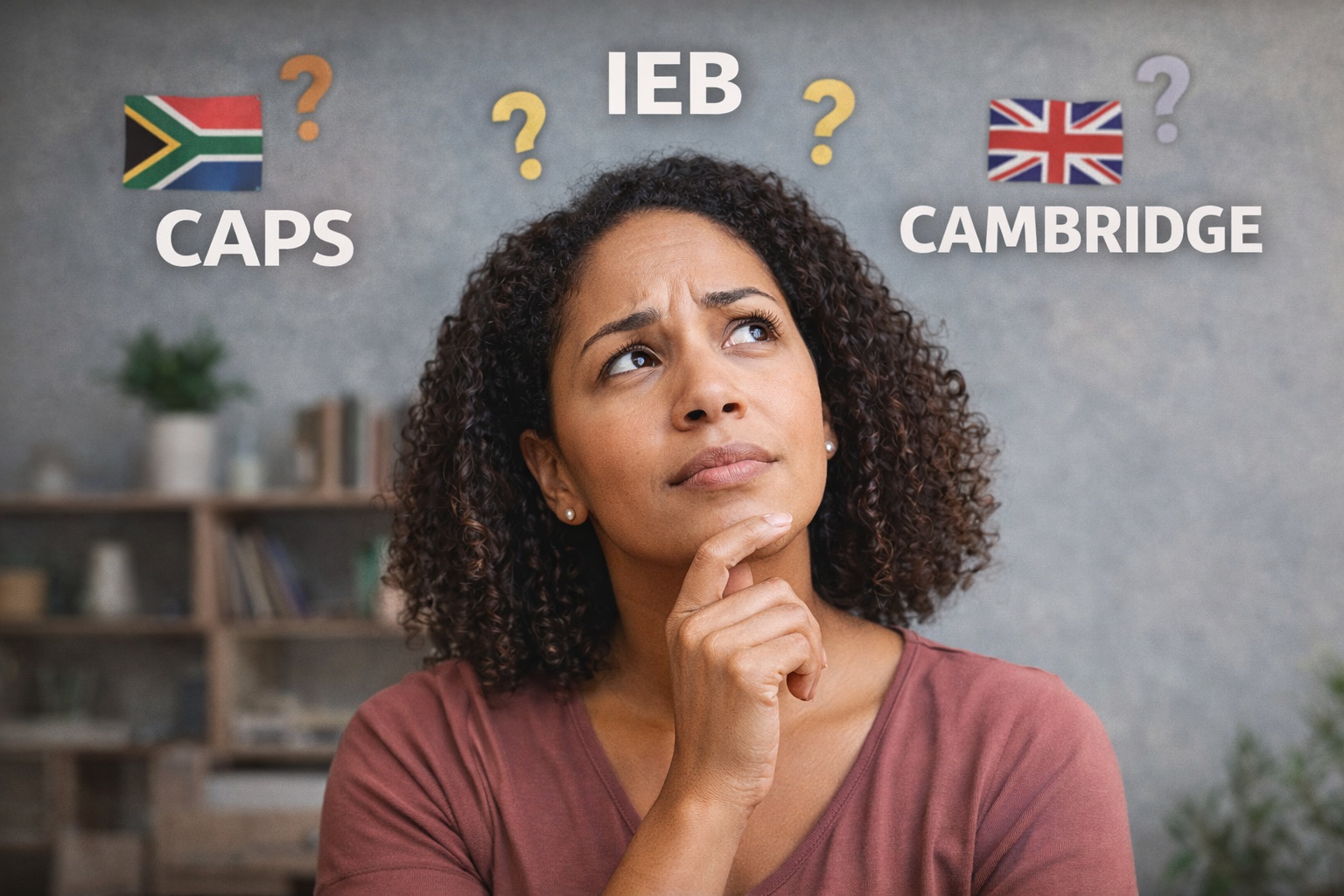
Parents are often told that choosing the right curriculum will determine a child’s academic future. This places pressure on the decision, but it also oversimplifies the problem. Learners do not experience a curriculum as a label. They experience it as daily lessons, homework demands, assessment style, and exam pressure.
Most academic difficulties arise not because a curriculum is poor, but because its expectations do not match the learner’s current skills, habits, or level of independence.
CAPS: Structured, Guided, and Predictable
The CAPS curriculum is South Africa’s national education system. It was designed to ensure uniform coverage, standardised pacing, and consistent assessment across schools. Teachers follow a prescribed schedule, and learners move through the syllabus together.
CAPS works best for learners who benefit from routine and close guidance. Lessons are teacher-led, and assessments reward correct application of taught methods. Exams are structured and familiar. This provides stability and predictability, especially for learners who need clear direction and steady reinforcement.
The limitation is that conceptual weaknesses can remain hidden. Learners may perform well by memorising procedures without fully understanding the ideas behind them.
CAPS generally suits learners who:
- Need structure and routine
- Rely on teacher guidance
- Perform best with predictable assessments
IEB: Structured, but Demanding Understanding
The IEB curriculum follows the same content framework as CAPS but applies a different assessment philosophy. It expects learners to demonstrate understanding, interpretation, and clear reasoning. Language precision matters more, and questions are less predictable.
Assessment is spread across the year, placing emphasis on consistency rather than last-minute performance. Learners must manage workload, meet deadlines, and articulate their thinking clearly.
IEB sits between CAPS and Cambridge. There is structure, but less hand-holding. Learners are guided, but expected to take ownership of their learning.
IEB generally suits learners who:
- Cope well with structure but want more challenge
- Can explain answers in words
- Manage ongoing assessment effectively
Cambridge: Independent, Conceptual, and Depth-Focused
The Cambridge curriculum is an international system designed for flexibility and depth. It is not tied to South African pacing and often prioritises fewer topics taught more deeply.
Cambridge assessments test whether learners can apply understanding to unfamiliar problems. There is less scaffolding and fewer cues. Success depends on strong foundations, independence, and comfort with abstract thinking.
This works well for self-directed learners. For others, the lack of structure can feel overwhelming if independence is introduced too early.
Cambridge generally suits learners who:
- Learn independently
- Enjoy conceptual problem-solving
- Are comfortable with uncertainty
Verdict: How Parents Should Think About the Choice
Curriculum choice should reflect learner readiness, not aspiration alone.
Learners who need support, routine, and steady guidance tend to do best in CAPS.
Learners who are structured but ready to think more independently often thrive in IEB.
Learners who are highly independent and conceptually strong may benefit most from Cambridge.
Problems arise when learners are placed into systems that demand skills they have not yet developed. This rarely results in immediate failure. It appears gradually through stress, uneven marks, and declining confidence.
Where LevelUp Fits In
This is where LevelUp becomes relevant.
Curriculum choice is not only about selecting a system. It is about ensuring that the learner has the skills that system assumes. Many learners struggle not because they chose the wrong curriculum, but because they were not supported through the transition.
LevelUp works across CAPS, IEB, and Cambridge. Our role is to:
- Identify gaps between curriculum expectations and learner readiness
- Strengthen foundational understanding, especially in Mathematics and Sciences
- Support learners as they move between systems or adjust to higher demands
We do not push learners toward a specific curriculum. We help parents understand whether a learner is ready for a curriculum and what support is required if they are not.
In many cases, the correct decision is not changing the curriculum, but changing the level of academic support around the learner.
Curriculum determines the rules of the game. Support determines whether the learner can play it confidently.